Ever wondered why one t-shirt costs $20 and an almost identical one costs $60? Or how two brands using the same fabric and the same construction can land on wildly different price tags?
Most founders treat clothing pricing as an overly simplistic formula which goes something like; cost multiplied by a magic profit multiplier equals price. Done.
This mindset is wrong.
Clothing pricing is a stack of decisions and most of that stack is never explained to you until you’ve already committed to a factory, a fabric supplier, and a launch date.
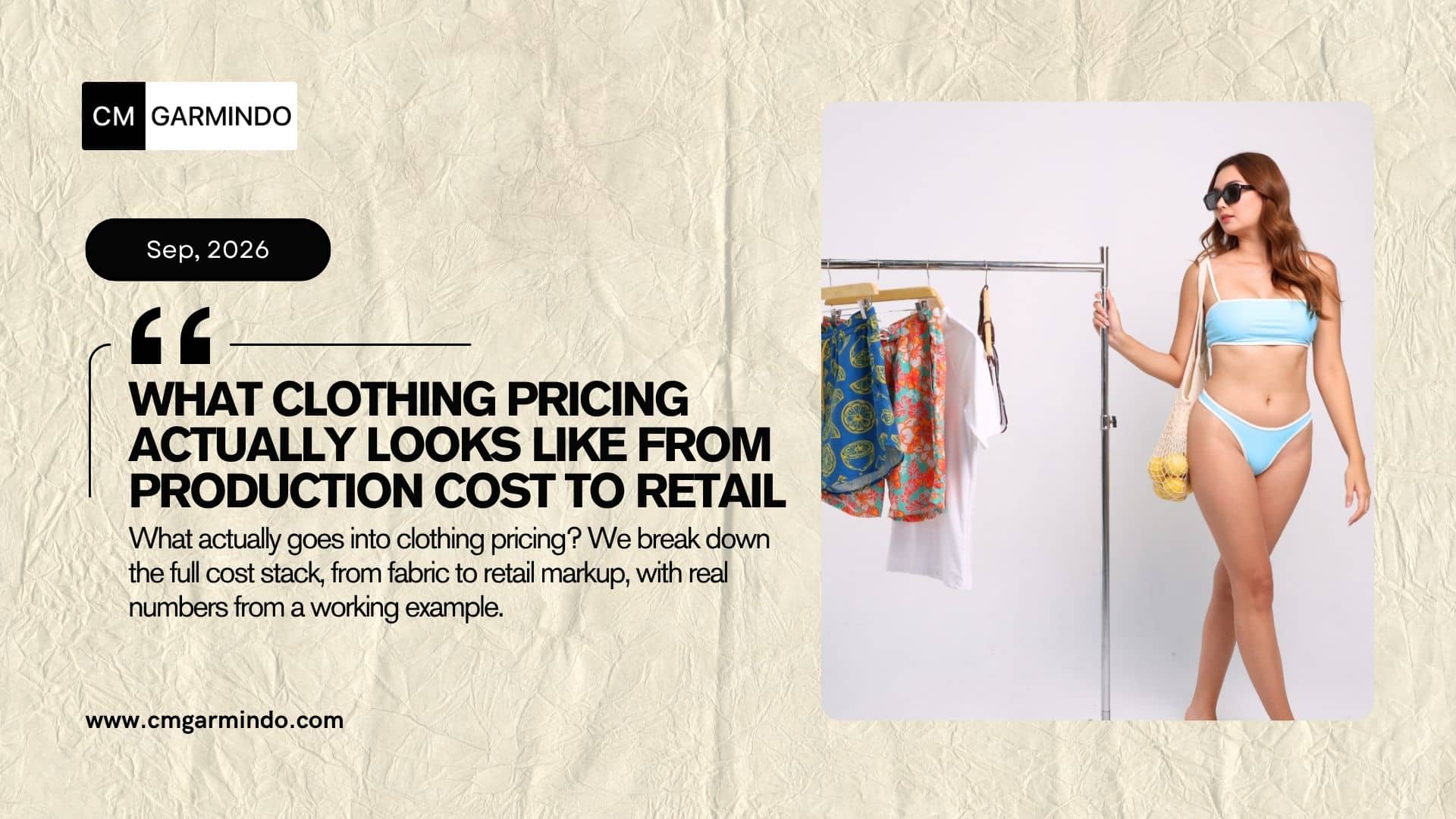
In this article, we break down what clothing pricing actually looks like, from the first production run through to the moment your product is ready for a customer to buy.
The Real Cost Stack Nobody Shows You
Everyone shows you fabric cost and CMT (cut, make, trim). Almost nobody shows you the rest of what actually lands in your invoice:
- Fabric and trims; the obvious one
- CMT; labour to construct the garment
- Sampling amortisation; those three “nearly right” samples before the right one isn’t free, and that cost has to live somewhere in your pricing
- Freight and duty; getting product from factory to warehouse, plus whatever import tariff your country applies when shipments come from Indonesia
- Packaging; polybags, hang tags, paper wrap, greeting cards, branded packaging if you’re doing it properly
- Rework and defect rate; the small percentage of units that fail QC, which someone still has to pay for
If your cost number only covers fabric and CMT, you’re not pricing a real, sellable product; you’re pricing a sample.
What a Real Clothing Pricing Breakdown Looks Like
Let’s make this concrete instead of theoretical. Take a basic sleepwear set:
|
Line item |
Cost |
|
Fabric + trims |
$6.50 |
|
CMT |
$2.20 |
|
Packaging |
$0.60 |
|
Freight + duty (landed) |
$1.10 |
|
Landed cost (total production cost) |
$10.40 |
|
Wholesale price (roughly 2.2x landed cost) |
$23 |
|
Retail price (wholesale × 2, keystone markup) |
$46 |
That’s what clothing pricing actually looks like in practice: two stacked margin decisions, each shaped by who’s taking a cut at that stage.
Founders who price straight from landed cost to retail but skip the wholesale layer entirely get caught out mid-negotiation with a boutique buyer, because there’s no room left to give.
Where the Multiplier Actually Comes From?
The 2.5x–4x range you’ve probably seen in pricing guides is built from three separate components stacked together:
- Retailer margin (wholesale channel). Plenty of brand owners never factor this in properly, and it costs them the ability to expand into wholesale later. When you sell wholesale, your retail partner typically doubles your wholesale price to reach their own retail price — meaning, roughly half of the final retail price goes to them, not you. Your wholesale price needs your own margin baked in before that doubling happens, which is why wholesale-focused brands need a leaner internal cost structure to stay profitable once the retailer takes their cut.
- Discount and return buffer. To keep stock moving through slower demand periods, you need to build room into your pricing for discount seasons — mid-year sales, end-of-season clearance, and returns. If your margin only works at full price, it doesn’t really work.
- DTC (direct-to-consumer) at full price. Selling direct means no retailer cut, but you’re now covering your own marketing and operational costs instead — ads, payment processing fees, customer service, warehousing. That math only holds if your customer acquisition cost stays under control.
What’s something that can affect pricing?
Cost calculation methods are the same from brand to brand; but the inputs change.
Take, for example, MOQs (minimum order quantities). One of the decisions a brand has to make.
A low MOQ is often the reason a founder chooses a particular manufacturer in the first place. Low MOQs means low risk.
But a lower MOQ almost always means a higher per-piece cost, which quietly thins your margin, especially if you’re targeting a price-sensitive market that can’t absorb a higher retail price.
The formula stays the same. The real numbers depend entirely on what you’re actually making, and at what MOQ.
How CM Garmindo Builds Pricing Reality Into Development
Every style in our white label sleepwear, swimwear, resortwear, and activewear collection is developed from trend and bestseller data, so founders get a realistic cost baseline from the very first conversation.
If you’re trying to work out what your clothing pricing actually looks like before you’ve committed to a factory, that’s the conversation we have with founders every week.
Explore the collection at shop.cmgarmindo.com, or get in touch to talk through what you’re building.